September 13th, 2013
A couple of my non-Muslim friends and colleagues at work – you know who you are -, even after all those years, keep asking me how this “Halal”-thing and this “Fasting”-thing works. I’m tired of answering the same questions every year so from now on I will refer you to this article.
So here we go, just for you…
Halal
Something is considered Halal when it’s permitted. This doesn’t only refer to what we’re allowed to do or say but also to what we’re allowed to eat.
The opposite of Halal is called Haram, forbidden.
So Muslims are permitted to eat what is considered “Halal” and what is Haram may not be eaten.
Anything made from pork (besides blood, carrion, alcohol etc.) is per se considered Haram. We’re not allowed to eat it and pretty much every Muslim that I know will be disgusted by only the thought of eating it.
Beef, chicken and other meat is considered Halal, if – and only if – it was slaughtered according to Islamic principles.
To cite Wikipedia here:
[…] the animal must be slaughtered with a sharp knife by cutting the throat, windpipe and the blood vessels in the neck (while the animal is conscious), causing the animal’s death without cutting the spinal cord. Lastly, the blood from the veins must be drained […]
Basically animals have to be slaughtered in the name of ALLAH(swt) and solely for eating them. Killing an animal for sports, for fun or for any other reason than eating it is not permitted. When slaughering an animal ALLAH(swt)’s name has to be invoked.
Fish doesn’t need to be slaughtered. We can eat fish anytime with no special preparations.
So all of the above implies that going to McDonalds for a burger doesn’t work for us. Some of their burgers don’t contain any pork but beef or chicken… but that beef or chicken is not slaughtered according to Islamic principles, so it’s Haram for us. Besides that you know that nowadays it’s not uncommon to buy beef and secretly the producer has mixed pork into it because it’s cheaper and “stretches” the mass and therefore increases his profits.
Alcohol is also Haram to us, so when I go to a restaurant I specifically ask the waiter if the pasta or whatever I’m about to order is being cooked with any alcoholic ingredient (wine poured over the sauce etc.).
And then there’s sweets that contain Gelatine, a mass that is produced from pork and beef. Even if it’s just a tiny percentage it’s Haram to us.
One more thing that many Muslims don’t know is that certain clear apple and orange juices are cleared with Gelatine. They juice is filtered through it to remove the little bits and particles of pulp and that makes them so clear with a uniform color, just like water.
Medicine and alcohol is the most complicated case. There are exemptions and rules but I avoid any medicine that contains alcohol and try to find an alternative that doesn’t contain any alcohol.
All of the above is very simplified and I have not mentioned all exemptions and special cases but it should give you a pretty good idea about the concept of Halal and Haram when it comes to food.
Fasting
I’ll make this quick and simple, so here are my answers to the (same) questions that I get asked and comments that I hear every single year:
“You can’t even drink water?”
No.
“Isn’t that hard, especially in the summer?”
No. If you know the night ahead that you will be fasting tomorrow then your body will adjust to and prepare for it. I only know of a few people that actually get thirsty.
“Not drinking any water is not healthy.”
Nobody has died from not drinking any water for 8-16 hours (depending on where on earth you live). Two billion Muslims fast ~30 days a year and they’ve all survived it. Besides that fasting is considered a good cleansing method even by non-Muslim scientists.
“Come on, eat this. God is not looking ;-)”
He does see it. And besides that fasting is also about disciplining ourselves.
“And what if you accidentally eat something?”
Then I won’t get in trouble. The only thing that breaks my fast is eating deliberately.
“I know this one Muslim guy and he’s not fasting because he has to work.”
Yes, there are lots of such Muslims out there and unless he’s sick, she’s pregnant or exempted from fasting for any other reason then that’s his choice and between him and his creator. There are soccer players and millions of construction workers that are fasting so your argument is invalid.
“What if you miss a day?”
Then we’re obligated to make up for it shortly after Ramadan ends.
“Ramadan is at the same time every year?”
No, due to the different calendars Muslims and Christians are following Ramadan moves “up” the calendar by ~10 days every year. In 2014 it will be in the middle of summer, with the longest fasting period since more than 30 years.
“Why are you fasting anyway?”
In no particular order and with no claim that all of this applies to me here are the reasons Muslims will cite when you ask this question:
Because my religion tells me to, because it makes me feel with those that don’t have enough to eat, because it cleanses my body, because it cleanses my mind, because it disciplines me, because it strengthens my will, because it helps me lose weight, because it makes me patient, because it humbles me, because my sins will be forgiven, because I will be nearer to my creator, because it increases my faith and because it focuses me.
You will never understand all of this until you went through a month of fasting.
“What about those that live in places where there’s literally not dawn and sunset, e.g. Scandinavian countries?”
They have the option of either following the schedule of the closest country with a Muslim majority or following that of the city of Makkah in Saudi Arabia.
“Can’t you just sleep longer during Ramadan?”
We could and many do, especially because we have to get up for a few minutes in the middle of the night for prayer. For some of us falling back asleep takes time and we have to make up for the missed sleep as otherwise it’ll be a really hard day. Your body can bear only so much. But sleeping half the day, as many twenty-somethings nowadays do, invalidates the purpose of fasting and is not permitted.
“So when sunset has come you’re stuffing your stomachs, right?”
No, it doesn’t work like that. Many do and enough people get admitted to the hospital every year but nowadays pretty much everybody has understood that it’s not healthy, doesn’t help you get through the following day more easily and defeats the purposes of fasting.
August 26th, 2011
A couple of years ago, when I was getting married, some of my non-Muslim/German friends asked me what to wear there and about the Do’s and Don’ts. I didn’t really have to explain much because they know me and my family well enough to know about our religious and cultural peculiarities, in comparison to what they were used to. But sometimes there is a lot more need to explain things.
What I realized in the past few years is that there is little to no knowledge about how things should “go” like when a non-Muslim is invited to a Muslim’s place. This post is for those that are interested in doing everything “correctly”. Actually, there is no right/wrong here as one shouldn’t expect that from each other, but for the culturally motivated I’ll try to be as precise as possible. Please note that much of what is written here is written from an Afghan standpoint but as Muslims from all over the world share common aspects in their cultures it also applies to others.
First off, and you might already be aware of that, many things we say are about making you not feel bad or embarrassed and making you feel taken care of and comfortable. So sometimes you might run into your Muslim friend, maybe even close to his house, and you chat for a while and then, when it’s time to part, he asks you to join him at his place for a coffee or have dinner with him and his family. As you’re close to his place and basically “in his hood” he will feel obliged to invite you over and be a “good host”. He will insist, with very convincing arguments, and try to persuade you and you might get the feeling that he’s serious about his offer.
Well, he’s not.
While he might not mind having you over at his place at that very moment the real reason why he invited you over is because certain complex and unwritten rules in our culture and our genes identify him as a host (which in fact he is not, as he met you outside). Those of us that have not spent their entire life in a different culture than ours and are not integrated or even assimilated will project a responsibility that they’re only supposed to execute among their own people on others as well.
At times this might go uncomfortably wrong, as the following real-life example explains:
A relative of mine moved to the U.S. and got his first job, as a taxi driver. He grew up in Afghanistan and was at quite a mature age when he moved to the U.S., a culture not very well-known to him. So he picks up this American guy and drives him to his destination. During the trip they talk about this and that and the entire atmosphere becomes very friendly. When they reach their destination my relative tries to be polite and declines to charge the customer what he owes him. Afghans usually start those friendly phrases with “be my guest today” which is nothing but politeness and not meant seriously. Well, the American, unfamiliar with Afghan/Muslim culture, takes the offer seriously, gets very happy about it, thanks my relative for the free ride and leaves.
Alright, so back to your invitation.
So now you made it into your Muslim friend’s house. Apparently the offer was meant seriously, meaning: you declined about a thirteen-thousand times but your host persisted and wouldn’t accept a “no”. The rules here are simple and probably not very different to those in other cultures:
Before you leave check your clothes. The more conservative your host’s family is the more conservative you should dress. This is usually no problem for men, unless you’re Scottish and prefer wearing a kilt in your spare time, but it is a bit more complicated for females: no sleeveless shirts, no cleavage, no mini-skirts. Try to show as little skin as possible whereas many Muslims in the West nowadays don’t feel uncomfortable anymore if the female guest wears pants (obviously) or a skirt that covers at least her knees and if her shoulders are also covered.
Little gifts are not unwelcomed but do leave the booze at home. Don’t bring any wine, beer or anything else that is alcoholic.
At the door you will be greeted by your counterpart. If you’re male it will be the man in the house and if you’re female it will be his better half. Depending on how conservative they are/aren’t both of them might be awaiting you at the doorstep to welcome you.
You may greet your host as you always do but as a man don’t stretch out your hand to the females. Here, again, depending on how conservative the family is you should wait and see if she stretches out her hand to you. Cheek-kissing a female, as a male, is not cool so don’t try that. If you want to impress your host big time you may place your right hand at your heart while you greet the females, ask how they are doing etc. and always keep a little bit more distance than you would if she wasn’t Muslim.
When you enter the house take your shoes off. Don’t ask if you can leave them on, just take them off and if your host doesn’t mind you running around his house in your shoes he’ll tell you to leave them on. Be persistent about taking them off and mention it at least two to three times. If your host still insists on you leaving them on then you’re free do so.
Do you see a pattern there? Yes, it’s all about back-and-forth. One party declines multiple times, the other party insists, multiple times. Whoever is serious about what he says will “win”. It always works out, there is no deadlock here. Never happened.
Once the actual invitation is taking place things might get a little more complicated.
As a male guest you’re pretty much restricted to staying in the living-room whereas females have more freedom in moving around the house.
In the conversations do avoid topics and jokes of ambiguous nature, especially if females are around. Don’t comment on the beauty of any females in the house as that will be taken as a grave insult to their modesty and the male host’s dignity and honour.
Feel free to talk politics. We love that and we’re all experts and know-it-alls in politics ;-)
Don’t mention the war (every Muslim knows or has experienced a war that he can talk and brag about), unless you’re on our side ;-) and don’t be insulted if discussions heat up. They often times do and nobody takes them personal.
At dinnertime we will try to stuff you, so you better be hungry. Don’t be afraid of not eating or trying something if you seriously don’t like it or are allergic to it. You’ll notice that, on the second invitation, whoever cooked the food on the first invitation will have memorized what you like and what you don’t like.
During or at the end of the dinner feel free to ask for recipes or for any of the food to be wrapped up so you can take it with you. We love that as the happiness of our guests with the meal we prepared means a lot to us, so special attention will be paid to that.
When dinner is over and conversations are ending, or not ending, you will notice that nobody tells you to leave and nobody makes any allusions for you to leave. You will notice that no Muslim will ever tell you to leave his house. I repeat: you will never be asked to leave and the host will never declare it to be late (meaning: “get the hell out”). As a guest it is your responsibility to call it a day and ask to leave. Actually, you don’t have to “ask” but in our, Afghan, culture we always end such evenings with words similar to “with your permission blahblah we will leave now as you might be tired as well blahblah and our kids are at home alone and blahblah”. Just make up anything, it doesn’t have to sound 100% realistic. Just don’t wait for your host to end the evening, that will not happen and you will see yourself sitting on his couch at 4am in the morning with him trying his best to keep you entertained and… comfortable.
June 27th, 2011
Every once in a while you invite us, the Muslims, to your weddings, birthdays, parties and Christmas celebrations.
Every now and then we can’t make it. Every now and then we don’t want to make it. It’s not personal, not at all. In fact, the mere gesture is what we appreciate more than you can imagine. Among us Muslims and Afghans it’s all about intention, respect and politeness and such invitations are considered as all three of them, especially because we live in a western society and you show that you care about us.
It might sound awkward to you but the reason why many of us try not to attend your events is because of you, not us, drinking alcohol. You might be wondering why we care about you drinking it as long as we, the Muslims, don’t. After all we’re not doing anything that goes against our religion, right?
Almost.
The problem is that we’re supposed to stay away from things that are clearly forbidden, “Haram”, to us. We’re supposed to stay away from temptation and anything else that is considered going against the teachings of Islam. Even as kids we’ve been taught that those things are not good to do so those memories and thoughts are deep inside us.
Secondly there’s the cultural aspect. As Afghans we’re overly protective of our spouses and children and we don’t want them to be around people that are drinking or acting in any other way that goes against our religion or culture. Even if we do attend your events, as sometimes it’s inevitable or it would be absolutely impolite not to attend them, you will often times see us coming over by ourselves, without our spouse, and leaving after a short while.
So it’s nothing personal. It’s not about not wanting to be in your company or not wanting to “hang around” but about us feeling uncomfortable in an environment that, since childhood, we’re taught is considered “Haram”.
Living in a western society this leads to a bunch of problems to some of us. I don’t attend some of the industry get-togethers because during those events people drink beer. I have skipped every Christmas party my employers have invited me to. And I skip the yearly joyride-boat-trip-thing that a former colleague keeps inviting me to since… years.
Simply put, they’re all not compliant with my upbringing and I feel uncomfortable being there. Still I feel bad about turning down your invitations as I know you mean it in a good way.
Before all of this sounds like a bad excuse let me stress again that we do appreciate the fact that you do invite us and that you do want us to be around you. We have been trained to keep those little pleasantries in our memory and in our hearts and to not forget them.
The least we can do is tell you honestly why we can’t attend. I think in the past I’ve been pretty honest about that to my non-Muslim friends. Good explanations, how awkward they may sound, are always better than a bad and obvious excuse.
May 3rd, 2009
In addition to English we have launched a few more languages on the Salam Business Club: German, French and Turkish as languages written from left-to-right and Arabic, Urdu and Persian which are based on Arabic letters and are written from right-to-left.
The thoughest part was making sure the pages are implemented in a fashion that makes it possible to apply a different CSS and language file to it so the complete content, text and writing direction changes. Once that system was set up we provided the translators with three different methods to translate the content: using a backend translation system, inline-editing of words they see on the site and the old-school way of translating the texts from within an Excel-sheet and importing them into the system.
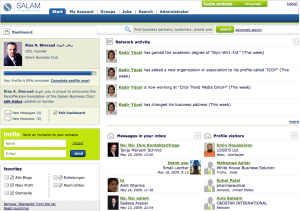
Kudos go out to Max, Dmitri, Amit, Jayawant and Pankaj for all the technical stuff and Ayla (Turkish), Eman (Arabic), Hossein (Persian), Nasir (Urdu) and Saloua (French) for the translations. Our biggest thanks goes to Eman who had the toughest job as she was the first translator and she probably had to spend more time beta-testing than translating the site. Her invaluable feedback paved way for the other translations. In case you’re looking for professional translators get in touch with me and I will connect you to those highly recommended folks.
May 4th, 2005
Today, again, I caught myself reading Jalal al-Din Muhammad Balkhi’s (also known as “Rumi”) poetry for hours. I don’t really know what makes me do this as I’m not into Sufism nor any other kind of spirituality that Rumi’s poetry expresses.
What does make me read his poems over and over again is the fact that much of his poetry forms the basis of classical Afghan music, such as Nashinas‘ beautiful version of “Beshnaw az nay”, meaning: “Listen to the reed”. That might have built the bridge.
Compare the poetry of “Listen to the reed” to “Baby hit me one more time” and you might understand what attracts me to Afghan music and Rumi’s poetry in general… ;-)
Check out khamush.com and RumiOnFire.com for a collection of his works.
December 14th, 2004
For weeks and months the world was supplied with images of westerners and alleged traitors being decapitated in Iraq. For non-Muslim viewers these pictures likely appear to be the maximum amount of horror a human being can quell, but for Muslims decapitation is beyond the fear factor. It’s an anology to the ancient times of the Prophet Mohammad (saw) and the legendary Salah al Din Yussuf Ibn Ayyub – in the west known as “Saladin”.
Ironically, Salah al Din was born in the same city as Saddam Hussein, Tikrit, but in stark contrast to Mr. Hussein, Salah al Din was renowned for his chivalrous and merciful nature during battles. He is regarded one of the greatest military leaders in the history of Islam and probably the most prominent figure of the times of the crusade period. His reputation for being fair-minded and just earned him respect even amongst his enemies, to wit: the Christians. One example is his relationship with Richard the Lionheart. Their relationship entailed a balance of intense military rivalry with a mutual degree of respect. This sort of balance was paralleled with his relationships with other kings, such as Frederick I of Hohenstaufen, also known as Barbarossa (“Redbeard”).
Now what do Mohammad (saw), Salah al Din and the resistance fighters have in common?
Well… actually… nothing!
The resistance fighters use the imagery and vocabulary that Islam and the history of Islam gives them to gain spiritual support in the Muslim world. Using knives and swords to fight and punish the enemy – by decapitating them, as common in many so-called Islamic countries – is an allusion to the times when Mohammad (saw) and Salah al Din fought their enemies with nothing other than their bare hands and swords.
The resistance fighters – claiming that western imperialism and especially American military actions are threatening Islam – punish those that they consider enemies with the same means that Salah al Din punished his enemies, e.g. the infamous knight, murderer, looter and plunderer Raynald of Chatillon, who threatened to attack the holy cities of Mecca and Medina. He was decapitated and probably by Salah al Din himself.
There is just one fact that the resistance fighters have not taken into account when trying to represent themselves along the same moral level as Mohammad (saw) and Salah al Din. The latter were – even in the western world – renowned for never killing the innocent and in countless cases exercising compassion when the highest degree of punishment was due.